
School Finance 101
Texas school finance can be complicated. These basics help explain how public schools in Texas are funded and how that funding connects to Leander ISD’s 2026 School Funding Election.
How Texas Schools are Funded

Texas public schools receive operating funding primarily through a combination of local property taxes and state funding, with a smaller federal funding share often designated for specific programs or purposes.
The amount available to a school district is determined through state funding formulas that consider factors such as student attendance and student needs. The key building block in that formula is the basic allotment, which is the base amount set by the state and used in calculating per-student funding.
Local and state funding are linked in Texas’ school finance formula. As local tax collections increase, state funding generally decreases. That means higher property values do not translate dollar-for-dollar into additional funding for Leander ISD.
This creates a relationship between local and state funds where when local tax collections increase, state funds to a school district decrease.
M&O vs. I&S

A school district’s property tax rate has two parts: Maintenance and Operations (M&O) and Interest and Sinking (I&S). They fund different types of expenses.
Proposition A in 2026 would affect only the M&O portion of Leander ISD’s tax rate. The I&S rate would remain unchanged.
Why the Basic Allotment Matters
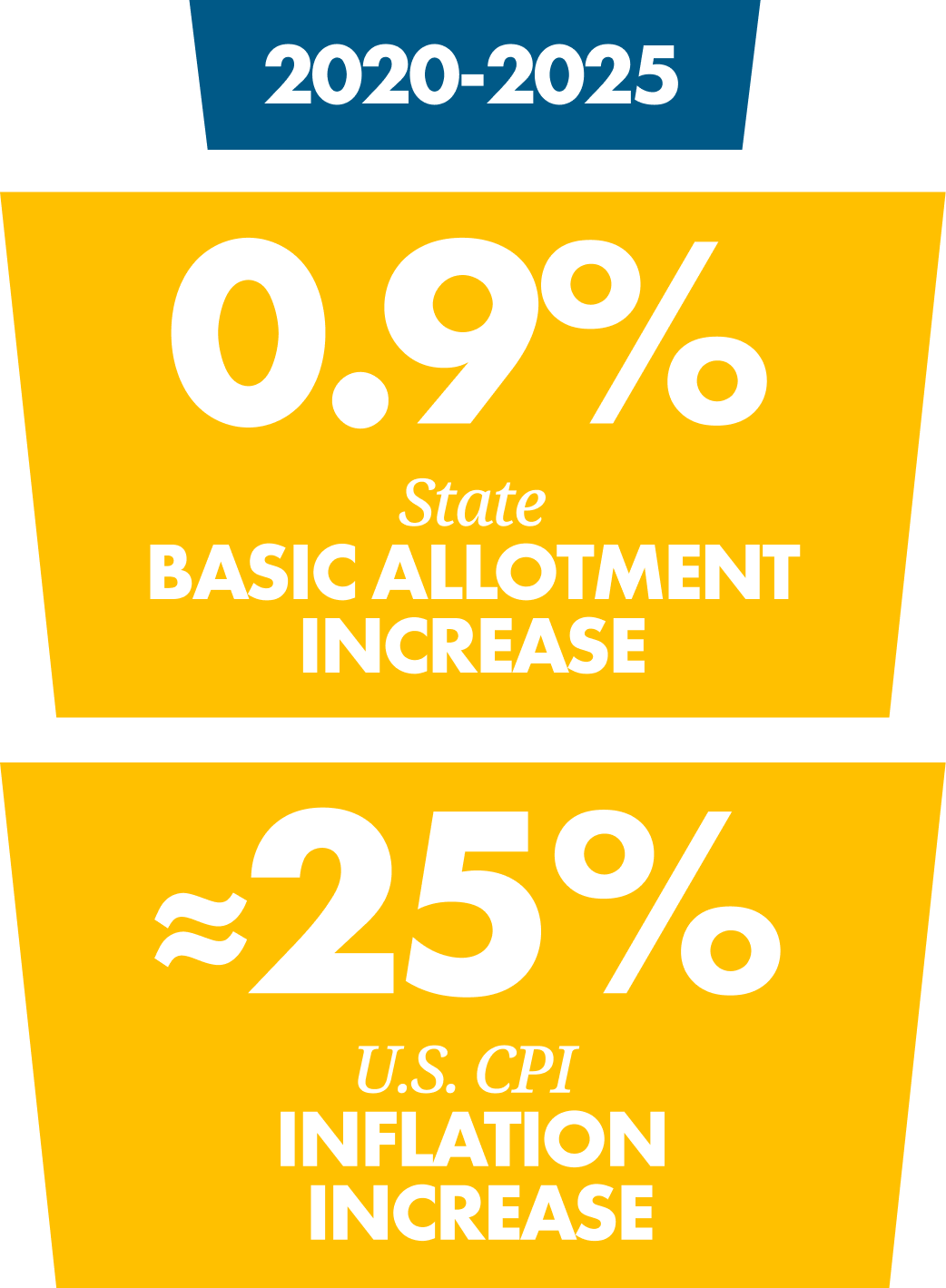
The basic allotment is a key building block in Texas’ per-student school funding formula, used with student attendance and other district and student factors to calculate funding.
Since 2019, inflation has increased costs by approximately 25%, while the basic allotment has increased by approximately 0.9%.
As a result, the purchasing power of school funding has not kept pace with rising costs.
What is a VATRE?

A Voter-Approval Tax Rate Election (VATRE) is required when a school district seeks voter approval for an M&O tax rate above the amount allowed without an election.
Leander ISD’s 2026 Prop A Election asks voters to consider ratifying an increase of 3 cents per $100 valuation to the district’s M&O tax rate.
If approved, those additional pennies would generate additional operating revenue for the district to fund day-to-day expenses, including instructional programs, student services and staff salaries.
Copper Pennies & Recapture

The additional 3 cents proposed through Proposition A in 2026 are sometimes referred to in Texas school finance as “copper pennies.” Unlike certain portions of the M&O tax rate, revenue generated by these additional pennies is subject to state recapture.
Recapture is part of Texas’ school-finance system and requires some locally collected property-tax revenue to be returned to the state.
Proposition A is projected to generate approximately:
- $12.1 million
Additional gross M&O tax collections - $5.36 million
Sent to the state through recapture - $6.7 million
Additional revenue for LISD
LISD’s Tax Rate Over Time
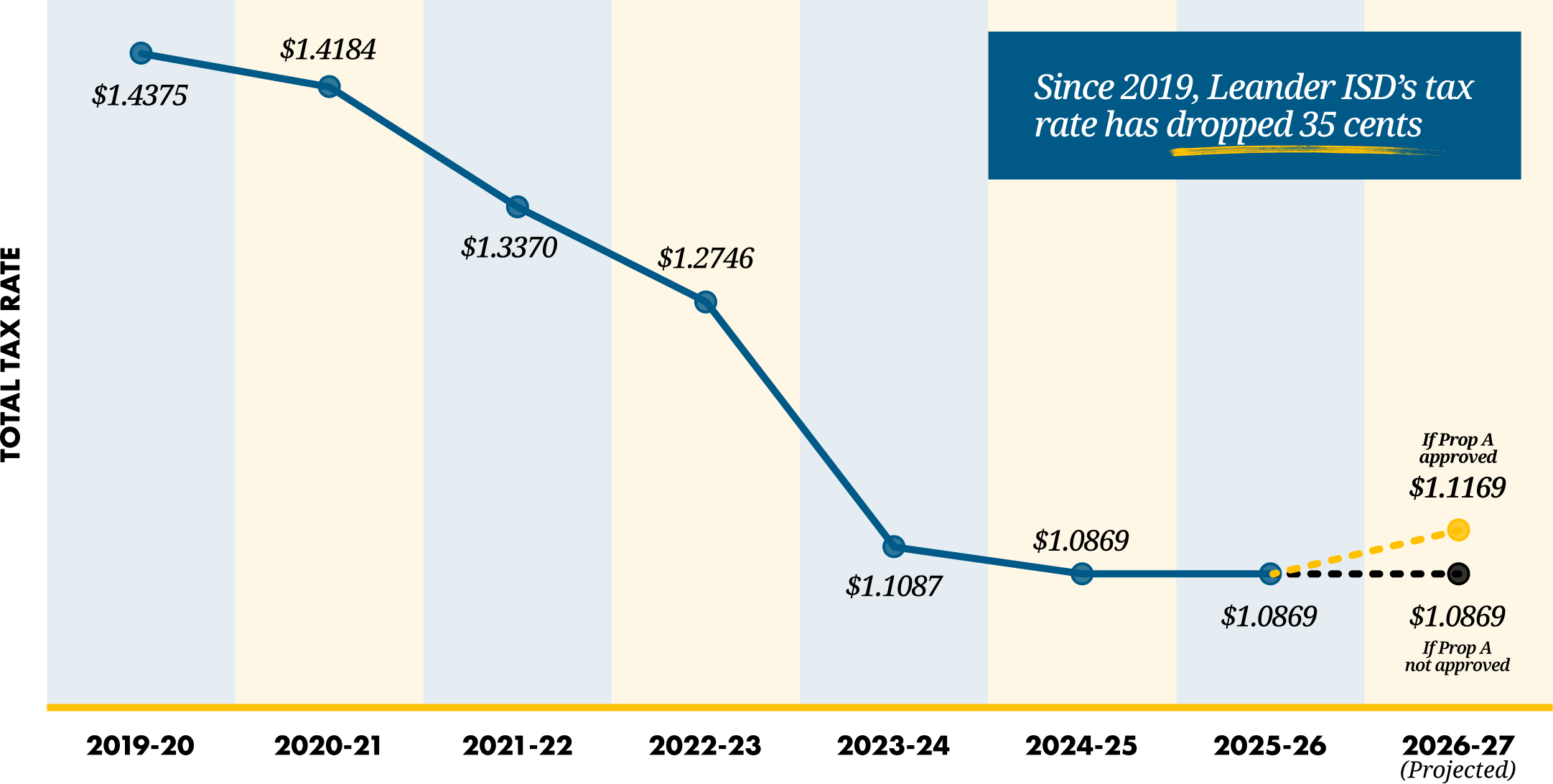
LISD’s total tax rate has decreased by 35 cents over the past seven years, from 2019-20 to 2025-26.
If Proposition A in 2026 is approved, 3 cents would be added to the M&O portion of the tax rate, which would then represent a 32-cent decrease since 2019-20.
The Leander ISD Board of Trustees sets the district’s property tax rate within the parameters established by state law. County appraisal district then determine the appraised value of residential and commercial property. Leander ISD does not determine property values.
A homeowner’s school property tax bill reflects both the taxable value of their property and the district’s tax rate.
Acronyms & Definitions

a
- Available School Fund (ASF)
All Texas school districts are entitled, under the Texas Constitution, to receive a designated amount from the state of Texas' Permanent School Fund. ASF distributions go toward a district's Tier 1 Entitlement and are based on the district’s prior year average daily attendance (ADA).
- Average Daily Attendance (ADA)
Average Daily Attendance (ADA) is the number of students in average daily attendance or the sum of attendance for each day of the minimum number of days of instruction.
b
- Basic Allotment (BA)
The Basic Allotment (BA) is set by the Texas legislature, guaranteeing every school district a certain amount of funding for each student based on the Average Daily Attendance (ADA). The BA is currently set at $6,215, with additional funding depending on district and student characteristics.
c
- Copper Pennies
A portion of the tax rate that brings in revenue above the Tier 1 Entitlement and can generate additional state aid but is subject to Recapture. Current estimates project 60 percent of this revenue would stay in Leander ISD and 40 percent would be sent back to the state as recapture. Leander ISD accessed six of the available nine copper pennies through a 2022 VATRE. Leander ISD is attempting to access the last three through Proposition A in 2026.
e
- Expenditures
Expenses or spending within a governmental entity – like a school district – are referred to as expenditures. Expenditures represent the spending of money.
f
- Fund Balance
A fund balance is like a savings account or emergency account that includes money that school districts do not allocate in budgets and hold in reserve. Fund balance is generated when annual revenues exceed actual operating costs. These funds are used to manage fluctuations in cash flow and to cover unforeseen expenses.
g
- Golden Pennies
A portion of the tax rate that brings in revenue above the Tier 1 Entitlement and is not subject to Recapture, meaning 100 percent of the revenue generated from this part of the tax rate stays in the district. They are referred to as “golden” because of their high value to a school district and because State aid can be generated to fully fund the calculated entitlement.
h
- House Bill 3 (HB3)
House Bill 3 is a bill passed by the 2019 Texas Legislature. As part of this legislation, HB3 created a system of funding meant to limit the amount of additional revenue generated from the M&O tax rate on rising property values to approximately 2.5 percent year over year. As a result, as property values grow, a school district is required to reduce the M&O tax rate to meet this 2.5-percent cap. Because of this, an increase in property values does not equal a proportional increase in revenues for a school district.
i
- Interest and Sinking (I&S)
The Interest and Sinking (I&S) part of the tax rate. Dollars from this portion of the rate can only be used to pay down existing debt. These tax collections cannot be used for operations, such as increasing teacher salaries or to build facilities.
m
- Maintenance and Operations (M&O)
The Maintenance and Operations (M&O) part of the tax rate. Dollars from this portion of the rate are used toward expenses like payroll, utilities, supplies and transportation.
r
- Revenues
The income of a governmental entity – like a school district – received from taxation and other local, state and federal sources. Revenues are used to finance the services provided to its citizens.
v
- Voter-Approval Tax Rate Election (VATRE)
State law requires that school districts seek voter approval to raise their M&O tax rate above a prescribed amount.
If the board adopts a tax rate that’s greater than the calculated rate set by law, that triggers an election called a Voter-Approval Tax Rate Election, which is held on a uniform election date (November). If the voters do not approve, then it reverts the M&O rate to the maximum allowed under state law.
w
- Weighted Average Daily Attendance (WADA)
Weighted Average Daily Attendance (WADA) is an adjusted student count taking into account student and district characteristics by which students in certain programs are “weighted” to generate additional funds.
Frequently Asked Questions
What is the current tax rate?
Leander ISD has a current total tax rate of $1.337. The tax rate is made up of two parts: an M&O rate of $0.8720 and an I&S rate of $0.4650.
How do rising property values impact the district?
Rising property values leads to an increase in the amount of tax revenue collected, but this does not mean the school district sees an increase in revenue. There is a relationship between local and state funds where when local tax collections increase, state funds to a school district decrease.
Rising property values do generate additional tax dollars; however, not all of those tax dollars are retained by the district. Excess tax collections are sent back to the state through recapture.
For a more detailed explanation, visit the How Texas Schools are Funded section above.
Resources
- Have a question? Submit your question through Let’s Talk or by texting 512-399-0068.
- 2022 School Finance Explainer video
- Visit the Financial Transparency page for detailed information about the district’s finances.